
 Russian

Playing melodies on a kalimba: what you need to know
Can anyone learn the kalimba, even without reading music? Making a sound by pressing and releasing a tine is certainly not difficult. You can also find tablature online: diagrams showing which tines to play and when.
It sounds simple: choose an instrument, practise plucking the tines, open some tabs and learn your favourite tunes.
You might play “Kalinka”:
Or music from Pirates of the Caribbean:
Yet this is where someone with no knowledge of musical notation may encounter difficulties. Let us explore a little music theory.
Many familiar instruments use a common system of note names and pitches, allowing them to play together in ensembles and orchestras. A major or natural minor scale is diatonic: it contains seven different notes per octave. This is a property of the scale, rather than a separate tuning system used by every instrument.
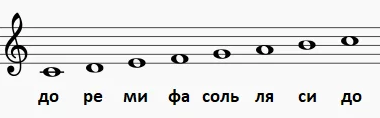
Fig. 1 — piano, flute and other instruments: notes shown in ascending order
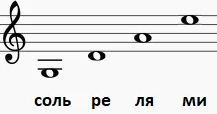
Fig. 2 — violin
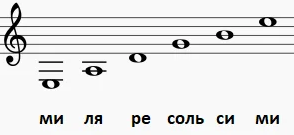
Fig. 3 — six-string guitar
These diagrams show pitches as an ascending sequence, from low on the left to high on the right.
A kalimba also has a tuning: each tine produces one note at a particular pitch. Unlike many traditional African mbiras with their own tuning traditions, modern kalimbas intended for Western music commonly use a familiar diatonic scale.
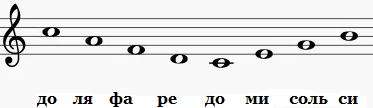
Fig. 4 — an eight-tine kalimba in C major
A key difference is the layout. On a common kalimba, the notes alternate outwards from the centre, with every other note on each side.
Schematically, it looks like this:
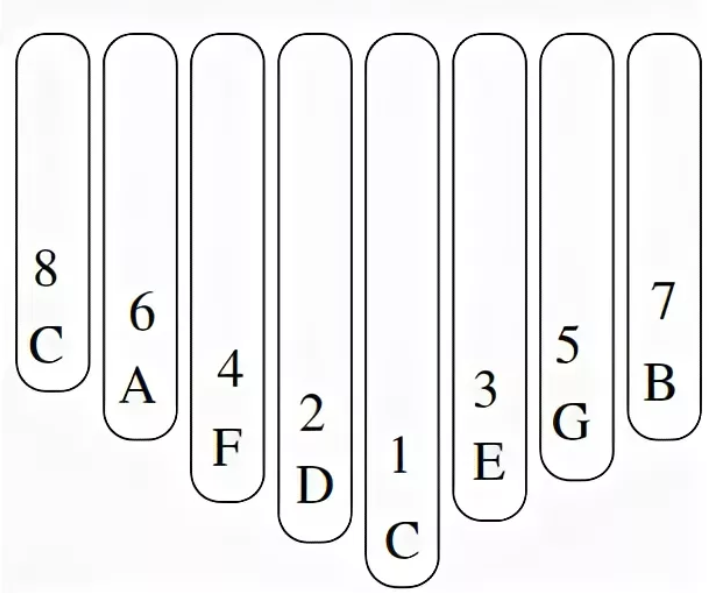
Fig. 5 — an eight-tine C major kalimba
You might say: “It is just a different arrangement. Once I understand it, I can play a melody.” Yes, provided your instrument has the notes and range required by the arrangement. It matters that the example in Fig. 4 is specifically in C major.
We will look at why the following sequence is called C major, and how other scales are built, in the article about changing keys.

Fig. 6 — the C major scale
This brings us to a common problem: if your kalimba is tuned to a different key, you may not be able to follow a YouTube performance or a set of tabs exactly as written.
To adapt melodies for your instrument, it helps to understand the basics of keys, scale degrees, intervals and modes.
Think of singing. If a song's highest note is beyond your voice, the key may be too high for you. You can lower the whole melody to make it comfortable. If the lowest note is too low, you can raise it instead.
Moving a melody into another key is called transposition. There are several ways to do this. Once you understand the process, you can often adapt a tune to your kalimba. For example, if a video uses a G major kalimba and yours is in C major, transposing the melody may let you play it, provided the range and required notes fit.
Another option is to retune the kalimba by changing the tine positions. This is most useful when you want to change its usual key. The instrument's design and tine lengths limit how far it can be retuned while still sounding good, so a wholesale change is not always the best solution. Routine tuning is a separate, useful skill: from time to time, a kalimba needs small corrections to stay in tune.
Finally, listen to a traditional instrument whose enchanting tuning may sound unfamiliar to ears accustomed to Western music: